
If you are planning a Tibet Trip from Guangzhou, the first decision is actually quite simple: how much time do you want to spend getting to Tibet?
You can take the direct Guangzhou–Lhasa train, which takes more than two days. You can fly to Lhasa with a connection and arrive much faster. Or, if you like the idea of traveling by train but do not want to spend 53 hours on one, you can fly from Guangzhou to Xining and take the Qinghai–Tibet train from there.
For a short holiday, I would fly. For a longer trip, the Guangzhou to Lhasa train is worth considering because the railway journey becomes part of the experience. The Xining option sits somewhere between the two.
I am Metok, a Tibetan and the person behind TibetTrip. My approach is practical: help you understand the choices, compare routes and plan a trip that makes sense for your time, budget and interests.
1. Guangzhou to Tibet at a Glance
Guangzhou is far from Lhasa, but it is a convenient place to begin a Tibet journey because you have both railway and air connections.
| Option | Duration | Main advantage | Best for |
|---|---|---|---|
| Guangzhou → Lhasa by train | About 53 hours | Long Qinghai–Tibet railway experience | Travelers who enjoy trains |
| Guangzhou → Lhasa by flight | About 5–6 hours of flying, excluding layover | Saves several days | Shorter Tibet trips |
| Guangzhou → Xining → Lhasa | About 3h+ flight + 20–22h train | Combines flight and scenic train journey | Travelers wanting a compromise |
The railway distance from Guangzhou to Lhasa is about 4,980 km, making Z264 the longest direct train route to Lhasa. The current published schedule shows a daily departure from Guangzhou at around 09:26 and arrival in Lhasa at around 14:53 on the third day, with a journey of approximately 53 hours 27 minutes.
The straight-line distance between Guangzhou and Lhasa is much shorter, around 2,324 km. The railway has to follow China’s existing rail network, which explains why the train journey is more than twice as long.
So when someone asks me about the Guangzhou to Tibet distance, I usually ask them what they really want to know. If it is about flight time, the air distance matters. If it is about the train, the 4,980-km railway route is the useful number.
2. How to Get to Tibet from Guangzhou
Get to Tibet from Guangzhou by Train: Guangzhou to Lhasa Train
The Guangzhou to Lhasa train is one of the classic ways to enter Tibet.
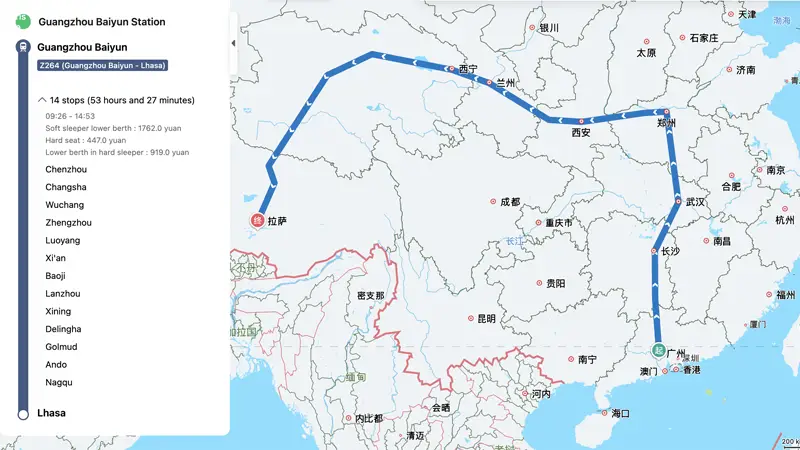
The current service is Z264, running daily from Guangzhou Baiyun Railway Station to Lhasa Railway Station. It travels through central and western China before reaching Xining and joining the Qinghai–Tibet Railway.
According to the current 2026 schedule, the train leaves Guangzhou Baiyun at about 09:26 and arrives in Lhasa at about 14:53 on the third day. The journey takes approximately 53 hours 27 minutes and covers around 4,980 km.
Guangzhou to Lhasa Train Schedule and Ticket Prices
| Item | Current information |
|---|---|
| Direct train | Yes |
| Train number | Z264 |
| Departure | Guangzhou Baiyun Railway Station |
| Arrival | Lhasa Railway Station |
| Frequency | Daily |
| Travel time | About 53 hours 27 minutes |
| Current published timetable | Around 09:26 → 14:53, third day |
| Railway distance | About 4,980 km |
| Hard seat | About RMB 447 |
| Hard sleeper | About RMB 865 |
| Soft sleeper | About RMB 1,468 |
| Main route | Guangzhou → Changsha → Wuhan → Zhengzhou → Xi’an → Lanzhou → Xining → Delingha → Golmud → Nagqu → Lhasa |
| Oxygen | Available |
| Hot drinking water | Available |
| Shower | No |
| Charging | Available, but limited |
| Wi-Fi | Do not rely on onboard Wi-Fi |
| Tibet Travel Permit | Required for foreign travelers entering Tibet |
These are current published reference fares. Railway schedules, ticket availability and fares can change, so check the actual travel date on China Railway / 12306 before making your final arrangements.
What is the Guangzhou–Lhasa train journey like?
The first day does not feel much like Tibet.
When the train leaves Guangzhou, you are still in southern China. The landscape is green and humid, and the railway passes through large cities and densely populated areas. During the following day, the scenery gradually changes as the train moves northwest through central China.
The real change comes after Xining.
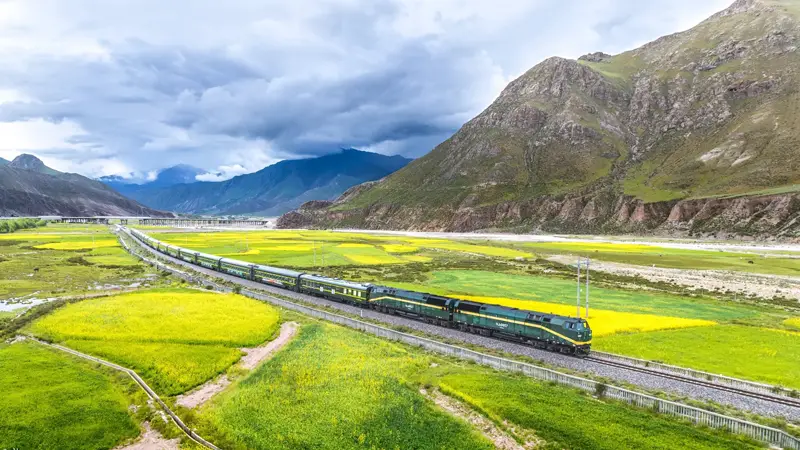
The railway climbs onto the Tibetan Plateau, passing broad grasslands, snow-covered mountains and enormous open valleys. You will also cross the high-altitude section around the Qinghai–Tibet Railway.
That is why I would not choose this train simply because it is cheaper than flying. If you have enough time, the journey itself is part of the Tibet experience.
Which train class should you choose?
For a journey of more than two days, I recommend a sleeper rather than a hard seat.
A hard sleeper is the practical budget choice. A soft sleeper costs more but gives you a four-berth compartment and generally a more comfortable environment for such a long journey.
Bring snacks, water, a few layers of clothing, headphones and something to read or watch. The train has food for sale, but having familiar snacks with you makes the journey easier.
Can you book a solo cabin on the Guangzhou to Lhasa train?
This is one of the most common questions I see.
Normally, no.
A standard soft-sleeper compartment has four berths. Buying one ticket gives you one berth, not the entire compartment.
You can ask about purchasing additional berths, but I would not plan your trip on the assumption that a private four-person cabin can be guaranteed. Railway ticketing rules and availability determine what is possible.
If you are traveling alone and privacy matters more than the railway experience itself, flying may actually be the more comfortable choice.
What about the Tibet to Guangzhou train?
The return service is Z266, Lhasa to Guangzhou. It also takes more than two days, so taking the train in both directions can add four or more days to your overall trip.
For that reason, some travelers take the train to Lhasa and fly back to Guangzhou.
I like this combination for people who want to experience the railway without giving up too much of their limited holiday.
Get to Tibet from Guangzhou by Flight: Guangzhou to Lhasa Flight
Flying is the obvious choice if your priority is time.
There are currently no nonstop Guangzhou to Lhasa flights. Flights from Guangzhou Baiyun International Airport to Lhasa Gonggar Airport require at least one stop. Current schedules show connections through places including Chengdu, Chongqing, Diqing, Kunming and other Chinese cities.
The actual flying time can be around 4 hours 35 minutes to 5 hours 35 minutes, depending on the connection. That does not include the waiting time between flights, so your total journey may be considerably longer.
Guangzhou to Lhasa Flight Options
| Route | Connection | Duration | Notes |
|---|---|---|---|
| Guangzhou → Lhasa | Chengdu | ~4h 35m+ | Frequent connecting option |
| Guangzhou → Lhasa | Chongqing | ~5h 10m+ | Common western China connection |
| Guangzhou → Lhasa | Diqing | ~5h 25m+ | Scenic southwest route |
| Guangzhou → Lhasa | Kunming | ~4h 45m+ | Another possible connection |
Flying time excludes the layover. Flight numbers and schedules change, so check the operating airline for your exact date.
There is one thing I would take seriously here: you are going from almost sea level in Guangzhou to Lhasa at about 3,650 m in a few hours.
Do not schedule a full sightseeing day immediately after landing.
Your first afternoon can be very simple: hotel check-in, a slow walk nearby, dinner and an early night. You do not lose anything by taking the first day slowly. You may actually enjoy the following days more.
Get to Tibet from Guangzhou via Xining
If you like trains but do not want to spend 53 hours on the Guangzhou–Lhasa train, look at Guangzhou → Xining → Lhasa.
You can fly from Guangzhou to Xining, then continue from Xining to Lhasa by train. Current train schedules include daily Xining–Lhasa services taking roughly 21–22 hours, with the route covering about 1,960 km.
This route makes sense for a traveler who wants to experience the most interesting part of the Tibet railway without spending two full days traveling from Guangzhou.
You can also spend a night in Xining before boarding the train. That gives you a little more breathing room instead of connecting immediately from an airplane to a long train journey.
My simple comparison:
- 7–8 days: Fly to Lhasa.
- 10–14 days: Consider the direct train or the Xining route.
- You love railway travel: Take Z264.
- You want a taste of the Qinghai–Tibet Railway but have limited time: Fly to Xining and take the train.
3. Guangzhou Tibet Trip Requirements: Chinese Tourist Visa and Tibet Travel Permits
There are two separate questions here:
Can you enter China?
And:
Can you enter and travel in Tibet?
Chinese Tourist Visa
If your nationality is not covered by China’s current visa-free policies, you need a Chinese Tourist Visa to enter China.
Visa-free rules depend on your passport and the policy in effect when you travel, so check the current Chinese entry requirements for your nationality before booking your trip.
Tibet Travel Permit
Foreign travelers need a Tibet Travel Permit to enter the Tibet Autonomous Region.
The permit is not something you normally obtain by yourself at a government office. Once your Tibet itinerary is confirmed, the licensed Tibet operating partner involved in your tour handles the formal permit application and related arrangements.
Do you need an Aliens’ Travel Permit for Everest or Nyingchi?
This is where many older articles are now outdated.
Since June 4, 2025, foreign travelers no longer need the separate Aliens’ Travel Permit for several regular tourist routes, including the standard Everest Base Camp route, Nyingchi scenic areas, Gyirong and some other popular routes.
For a normal Guangzhou–Lhasa–Everest or Guangzhou–Lhasa–Nyingchi itinerary, the important document is therefore the Tibet Travel Permit, together with the applicable China entry document.
Rules can vary for specific restricted locations, so the exact itinerary should always be checked before departure.
What if I want to visit Mount Kailash?
Mount Kailash is different.
For a Mount Kailash and Lake Mansarovar trip, you still need additional permits, including:
- Tibet Travel Permit
- Aliens’ Travel Permit
- Military Area Entry Permit
Ngari is a remote western region with additional travel controls, so do not use the simplified Everest or Nyingchi permit rules when planning a Kailash journey.
4. Find the Best Time for a Guangzhou Tibet Trip
Tibet can be visited in different seasons, but the best time depends on your route.
| Season | What it is like | Good for |
|---|---|---|
| April–May | Spring, Peach Blossom Festival | Nyingchi |
| June | Warmer, greener in eastern Tibet | Lhasa and cultural sightseeing |
| July–August | Main travel season, possible rain | General Tibet travel |
| September–October | Often clearer mountain views | Everest and classic Tibet routes |
| November–March | Cold and much quieter | Budget-conscious travelers who like winter |
For a first Guangzhou Tibet trip, I particularly like September and October if your schedule is flexible.
For Nyingchi, spring and early summer can be very attractive because the forests and valleys are greener.
For Everest, autumn often offers good visibility, although no month can guarantee clear mountain weather.
The important thing is not to choose a month simply because someone online calls it the “best season.” Think about the places you actually want to visit.
5. Guangzhou Tibet Trip Highlights: What to See
A Guangzhou to Tibet trip should not stop at Lhasa unless your time is very limited.
Lhasa
Spend enough time in Lhasa to settle into the altitude.
The Potala Palace, Jokhang Temple, Barkhor Street, Sera Monastery and Drepung Monastery give you a much better introduction to Tibet than immediately getting into a vehicle for a long road trip.
Yamdrok Lake
Yamdrok Lake is an easy addition to a central Tibet itinerary.
The journey takes you over high mountain passes and into a landscape of blue water, snow-covered peaks and broad valleys. It is one of the first places where many visitors really feel that they have arrived on the Tibetan Plateau.
Shigatse
Shigatse is home to Tashilhunpo Monastery and is an important stop on the road toward Everest.
It also makes sense as part of an acclimatization route because you do not have to jump straight from Lhasa into the highest and longest drives.
Everest Base Camp
The Tibet side of Everest is a road journey, not a quick excursion from Lhasa.
If Everest is your main goal, allow enough time for the journey. The landscape changes repeatedly as you travel west, and the road itself is part of the experience.
Nyingchi
Nyingchi feels very different from the dry high plateau around Lhasa.
If you prefer forests, rivers and mountain valleys, consider Basum Tso, Lulang and the Nyingchi region instead of trying to fit every famous attraction into one itinerary.
Mount Kailash and Lake Mansarovar
Kailash deserves its own planning.
The pilgrimage route around Mount Kailash is about 52 km, normally completed over three days, and crosses Dolma La Pass at about 5,630 m.
This is not an attraction I would add to a short Tibet holiday just because you have two spare days.
6. Guangzhou Tibet Trip Duration: How Many Days?
Your available time should determine your route, not the other way around.
| Available time | A sensible plan |
|---|---|
| 7–8 days | Fly to Lhasa, stay around Lhasa and nearby areas |
| 9–10 days | Lhasa + Yamdrok + Shigatse |
| 11–13 days | Lhasa + Everest Base Camp |
| 12–14 days | Lhasa + Nyingchi, depending on route |
| 15–18 days | Lhasa + Everest with a slower itinerary |
| 18–21+ days | Consider a Kailash-focused trip |
If you take the direct Guangzhou–Lhasa train, remember that the train alone uses more than two days.
That changes the calculation considerably.
For example, someone with 12 days might fly to Lhasa and have roughly 11 days available for Tibet after accounting for arrival and departure. If the same traveler takes the train in both directions, a large part of those 12 days is spent traveling between Guangzhou and Lhasa.
That does not make the train a bad choice. It simply means you should choose it because you want the train journey, not because you think it is the fastest way to Tibet.
7. Budget Tibet Trip from Guangzhou: How Much Does a Guangzhou Tibet Trip Cost?
There are three main costs to consider:
getting to Tibet + the Tibet tour + getting back to Guangzhou or your next destination.
Guangzhou–Lhasa transportation
Current published one-way train fares are approximately:
- Hard seat: ¥447
- Hard sleeper: ¥865
- Soft sleeper: ¥1,468
These are reference fares and should be checked for your actual date.
Flights are less predictable. Prices change with the season, airline, connection and how early you book.
I would not compare a ¥1,468 soft-sleeper ticket with a flight price without also asking how much time each option costs you.
Tibet tour costs
Once you are in Tibet, the larger part of your budget normally goes toward the tour itself.
When comparing a Guangzhou to Tibet tour, look beyond the advertised starting price.
Check:
- Group size
- Hotel category
- Number of sightseeing days
- Vehicle arrangements
- Entrance tickets
- Tibet Travel Permit arrangements
- Meals
- Airport or railway transfers
- Everest or Kailash permit requirements
- Whether optional activities cost extra
A lower headline price is not always a lower final cost if the itinerary is full of optional expenses or uses very basic accommodation.
At TibetTrip, my role is to help you compare these details and understand which itinerary fits your trip. If you decide to proceed, your enquiry is introduced to a licensed Tibet operating partner, who handles the formal tour contract, payment, permits and on-the-ground operation.
That distinction is important. I help you plan and compare; the licensed operating partner is responsible for the formal operation of the tour.
8. Frequently Asked Questions About a Guangzhou Tibet Trip
Is there a direct train from Guangzhou to Lhasa?
Yes. Z264 is the direct Guangzhou–Lhasa service. It currently runs daily and takes about 53 hours 27 minutes.
How far is Guangzhou from Lhasa?
The straight-line distance is about 2,324 km, while the railway route is approximately 4,980 km.
Is there a Guangzhou to Lhasa direct flight?
No. Current schedules show that Guangzhou–Lhasa flights require at least one stop.
How long does a Guangzhou to Lhasa flight take?
The actual flying time can be roughly 4 hours 35 minutes to 5 hours 35 minutes, excluding the layover. Your total airport-to-airport journey will therefore depend on the connection.
Is the Guangzhou to Tibet train worth taking?
If you enjoy trains and have enough time, yes.
If you only have a week in Tibet, I would fly instead and spend those extra days exploring Tibet.
Can I book a solo cabin on the Guangzhou to Lhasa train?
Not normally as a standard ticket.
A soft-sleeper compartment generally has four berths. You receive one berth when you buy one ticket. A completely private cabin should not be assumed to be available.
Is it better to fly Guangzhou to Lhasa or take the train?
For speed, fly.
For the railway experience, take the train.
For a middle option, fly Guangzhou to Xining and continue by train to Lhasa.
Do I need an Aliens’ Travel Permit for Everest Base Camp?
For the standard Everest tourist route, the separate Aliens’ Travel Permit is no longer required under the exemption introduced on June 4, 2025. The Tibet Travel Permit remains required, and specific itineraries should still be checked for any additional requirements.
Do I need an Aliens’ Travel Permit for Nyingchi?
The regular Nyingchi tourist routes covered by the 2025 policy change no longer require the separate Aliens’ Travel Permit.
Do I need an Aliens’ Travel Permit for Mount Kailash?
Yes. A Kailash–Mansarovar itinerary still requires additional permits, including the Aliens’ Travel Permit and Military Area Entry Permit, in addition to the Tibet Travel Permit.
Should I take the train to Tibet to acclimatize?
The train gives you a gradual physical approach to the plateau, but it does not guarantee that you will avoid altitude sickness.
If you fly directly from Guangzhou to Lhasa, the altitude change is much faster, so give yourself time to rest after arrival.
Can I travel from Guangzhou to Lhasa by train and fly back?
Yes, and I think this is a very sensible combination for some travelers.
You get the experience of the Guangzhou–Lhasa railway journey but do not spend another two days on the return train.
Is Xining a good alternative to taking the Guangzhou–Lhasa train?
Yes. If you want the Qinghai–Tibet railway experience but do not have enough time for the full 53-hour journey, flying to Xining and taking the train from there is worth considering.
My Advice for a Guangzhou Tibet Trip
If you are planning your Tibet Trip from Guangzhou, I would make the decision in this order:
First decide where you want to go in Tibet.
Lhasa only? Everest? Nyingchi? Kailash?
Then decide how many days you really have.
Only after that should you choose the train or flight.
With a week, I would not spend two days sitting on a train unless the railway journey itself is one of the reasons you are coming to Tibet.
With two weeks, the calculation changes. The direct Guangzhou–Lhasa train can become a memorable part of the trip, especially if you enjoy watching China gradually change outside your window.
And if you cannot decide, the Xining route is worth a serious look.
Tibet planning is often confusing because older information stays online for years, particularly around permits and train arrangements. The rules have changed, and different Tibet routes can have very different requirements.
That is where I believe a local perspective is useful.
At TibetTrip, I can help you understand the route, compare the realistic options, review the itinerary and coordinate your enquiry with the appropriate licensed Tibet operating partner. I do not want to make the trip sound easier than it is, and I do not think every traveler needs the same itinerary.
If you tell me your dates, how many days you have, whether you prefer train or flight, and whether Everest, Nyingchi or Kailash is on your list, we can start from there.
For a Guangzhou to Tibet trip, there is no single “best” route.
There is only the route that makes the most sense for your trip.