
Taking a train to Tibet is not simply a cheaper way to reach Lhasa. For many travelers, the journey itself is part of the experience, especially the section of the Qinghai-Tibet Railway between Xining and Lhasa.
There are two practical ways to travel to Tibet by train: take a direct train from a major Chinese city such as Beijing, Shanghai, Xi’an, Chengdu or Guangzhou, or travel to Xining first and take the shorter Xining–Lhasa train.
For most travelers who mainly want to experience the Qinghai-Tibet Railway, I would choose Xining–Lhasa. It takes about 20–21 hours and covers the main high-altitude railway section without spending another day or two on the train before reaching the plateau.
I’m Metok, a Tibetan born and raised in Tibet. I run TibetTrip to help international travelers understand Tibet, choose the right train route and plan their trip with practical local knowledge.
This guide covers Tibet train routes, tickets, schedules, prices, sleeper classes, the Qinghai-Tibet Railway, oxygen and altitude, Tibet Travel Permit requirements, and what to expect during the journey.
Tibet Train at a Glance
| Item | Practical information |
|---|---|
| Main destination | Lhasa |
| Main railway gateway | Xining |
| Main high-altitude railway | Qinghai-Tibet Railway |
| Xining–Lhasa distance | About 1,956 km |
| Xining–Lhasa travel time | About 20–21 hours |
| Main sleeper classes | Hard sleeper and soft sleeper |
| Lhasa altitude | About 3,650 m |
| Highest railway sections | Above 5,000 m |
| Oxygen system | Yes |
| Required Tibet document | Tibet Travel Permit |
| Best route for the railway experience | Xining–Lhasa |
If your main goal is the Qinghai-Tibet Railway experience, Xining–Lhasa is usually the most practical choice.
If the train journey itself is part of a longer China trip, a direct Beijing, Shanghai, Xi’an, Chengdu or Guangzhou–Lhasa train may make more sense.
China Tibet Train Route and Map
The easiest way to understand the Tibet train network is to divide the journey into two sections:
Chinese Mainland → Xining → Qinghai-Tibet Railway → Lhasa
A typical route looks like:
Beijing / Shanghai / Guangzhou / Chengdu / Xi’an → Lanzhou → Xining → Delingha → Golmud → Kunlun Mountains → Tanggula area → Amdo → Nagqu → Damxung → Lhasa
Not every train stops at every station. The exact stops depend on the train number and timetable.
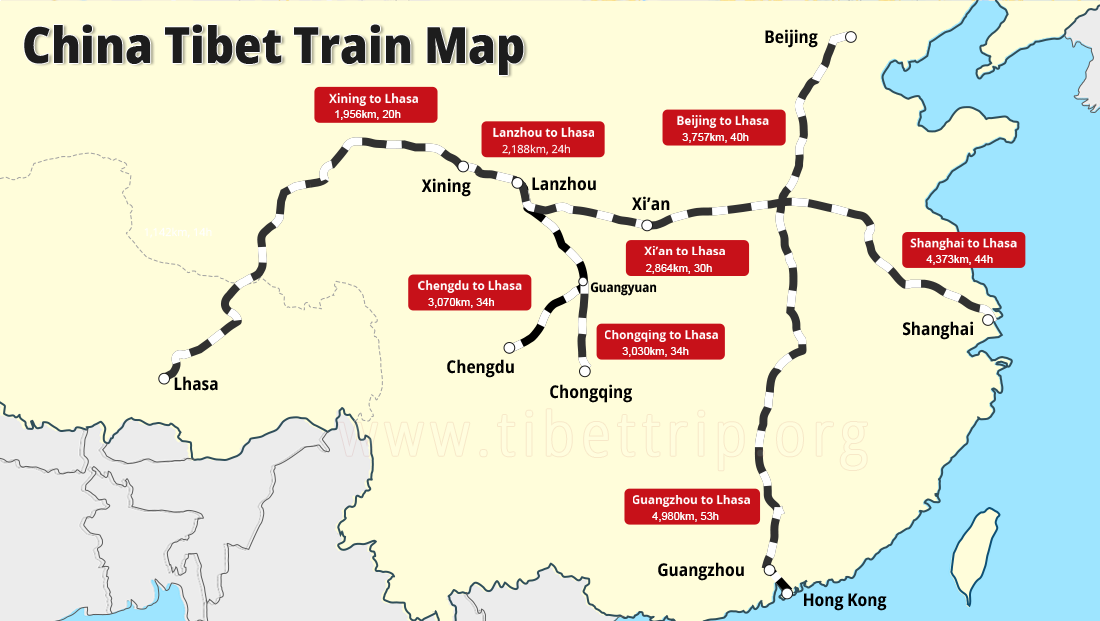
Qinghai-Tibet Railway: The High-Altitude Section
The section that most travelers are interested in is the Qinghai-Tibet Railway.
It begins around Xining and continues through Qinghai before crossing the Tibetan Plateau toward Lhasa.
The Xining–Lhasa section is roughly 1,956 km and includes some of the highest railway sections in the world.
This is also why Xining is such a useful gateway for travelers who want the railway experience without spending 40–50 hours on a train.
Tibet Train Routes to Lhasa
There is no single best Tibet train route for everyone.
The right choice depends mainly on:
- where you are already traveling in China
- how much vacation time you have
- whether the train journey itself is important to you
- whether you want the shorter Xining–Lhasa experience
| Route | Approx. distance | Approx. travel time | Best for |
|---|---|---|---|
| Xining → Lhasa | 1,956 km | 20–21 hours | Best overall railway experience |
| Xi’an → Lhasa | 2,864 km | 30–31 hours | Xi’an + Terracotta Warriors + Tibet |
| Chengdu → Lhasa | 3,070 km | About 34–35 hours | Travelers already visiting Chengdu |
| Beijing → Lhasa | 3,757 km | About 40 hours | Classic long-distance China train journey |
| Shanghai → Lhasa | 4,373 km | About 44–45 hours | Travelers starting in eastern China |
| Guangzhou → Lhasa | 4,980 km | About 53 hours | Travelers who genuinely enjoy long train journeys |
Train schedules and fares change, so these figures should be treated as planning references rather than fixed booking information.
Who Should Take the Tibet Train?
The train is not automatically the best choice for every traveler. I would make the decision based on your time, starting point and what you want from the journey.
| If you… | My suggestion |
|---|---|
| Have plenty of time | Take the train |
| Want the Qinghai-Tibet Railway experience | Xining → Lhasa |
| Already travel in Beijing | Beijing → Lhasa |
| Already travel in Shanghai | Shanghai → Lhasa |
| Already travel in Xi’an | Xi’an → Lhasa |
| Already travel in Chengdu | Chengdu → Lhasa |
| Have limited vacation days | Consider flying |
| Are mainly interested in experiencing the Qinghai-Tibet Railway | Travel to Xining first |
| Want to combine a China trip with Tibet | A direct train from your China itinerary can work well |
If you only want to reach Lhasa quickly, flying is more practical.
If the railway journey is part of your travel experience, taking the train can be worth the extra time.
Xining to Lhasa Train: The Most Practical Option
For travelers who specifically want to experience the Qinghai-Tibet Railway, Xining to Lhasa is the route I recommend most often.
The journey takes roughly 20–21 hours.
A practical itinerary is:
Fly or train to Xining → stay overnight if needed → take the train to Lhasa → continue your Tibet itinerary.
You get the main plateau railway experience without committing to a 40–50 hour train journey.
For travelers with limited vacation time, this is often the best balance between the railway experience and time spent actually traveling in Tibet.
Xining to Lhasa Train Timetable
Current schedules should be checked for your exact travel date because departure times and train numbers can change.
| Item | Reference information |
|---|---|
| Route | Xining → Lhasa |
| Travel time | About 20–21.5 hours |
| Distance | About 1,956–1,972 km |
| Frequency | Daily services are available on current schedules |
| Hard sleeper | About CNY 495–521 |
| Soft sleeper | About CNY 781–808 |
Check the actual train number and departure time before booking.
Chengdu to Lhasa Train
The Chengdu–Lhasa train takes roughly 34–35 hours.
This is a sensible option if Chengdu is already part of your China itinerary and you would rather continue to Tibet by train than fly.
A practical combination is:
Chengdu → Lhasa → Shigatse → Everest Base Camp
You can spend a few days in Chengdu before boarding the train instead of trying to connect a flight and train on the same day.
For current train numbers, departure times and ticket availability, check the exact travel date before booking.
Xi’an to Lhasa Train
The Xi’an–Lhasa train takes roughly 30–31 hours depending on the service.
Xi’an is particularly convenient for travelers who want to combine:
Xi’an + Terracotta Warriors + Tibet
For some itineraries, taking the train from Xi’an can make more sense than adding another flight connection.
Beijing to Lhasa Train
The Beijing–Lhasa train is one of the classic long-distance routes to Tibet.
The journey takes roughly 40 hours and crosses a large part of Chinese Mainland before reaching Xining and the Qinghai-Tibet Railway.
I would choose this route if the train journey itself is part of your China travel experience and you have enough time.
If your priority is simply reaching Tibet quickly, flying is more practical.
Shanghai to Lhasa Train
The Shanghai–Lhasa train takes around 44–45 hours and covers approximately 4,373 km.
This is a good option if your China trip already begins in Shanghai or eastern China and you have enough time for a two-day train journey.
It is not the route I would choose simply to experience the Qinghai-Tibet Railway. In that case, Xining–Lhasa is more efficient.
Guangzhou to Lhasa Train
The Guangzhou–Lhasa train is one of the longest direct train journeys to Tibet.
The journey takes roughly 53 hours and covers almost 5,000 km.
I would only choose this route if you genuinely enjoy slow travel and have enough time.
If your main goal is to experience the high-altitude railway section, traveling to Xining first is much more practical.
Tibet Train Tickets: Cost and Fare
Tibet train ticket prices depend on:
- departure city
- train number
- travel date
- seat or sleeper class
For planning purposes, current reference fares are approximately:
| Route | Hard Sleeper | Soft Sleeper |
|---|---|---|
| Xining–Lhasa | CNY 495–521 | CNY 781–808 |
| Chengdu–Lhasa | CNY 628–664 | CNY 998–1,035 |
| Xi’an–Lhasa | CNY 612–648 | CNY 970–1,006 |
| Beijing–Lhasa | CNY 720–763 | CNY 1,144–1,186 |
| Shanghai–Lhasa | CNY 794–842 | CNY 1,263–1,311 |
| Guangzhou–Lhasa | CNY 865–919 | CNY 1,490–1,526 |
These are budgeting references, not guaranteed prices. The exact fare should be checked for your train and travel date.
Soft Sleeper vs. Hard Sleeper
For a short overnight journey, hard sleeper is usually reasonable.
For 30–50 hours, I would choose soft sleeper if your budget allows it.
Soft Sleeper
A soft sleeper normally has four berths in a compartment with a door.
You get more privacy, fewer people in the compartment and a more comfortable setup for a long journey.
Hard Sleeper
Hard sleeper compartments normally have six berths and are open to the corridor.
They cost less and are perfectly workable for many travelers.
My practical rule:
- 20–24 hours: hard sleeper is fine
- 30–40 hours: soft sleeper is worth considering
- 40+ hours: I would choose soft sleeper
When should I book a Tibet train ticket?
It is best to contact us before the current 12306 ticket-release date for your journey. This gives us time to understand your preferred train, sleeper type and travel dates, and make sure the train plan fits your Tibet itinerary and Tibet Travel Permit arrangements.
China Railway releases tickets according to its current 12306 advance-sale window, which can change. Contacting us early does not mean your ticket is already confirmed. A train ticket is only confirmed after it has been successfully issued through the railway booking system.
What happens if my preferred Tibet train is sold out?
A sold-out train does not necessarily mean you need to change your Tibet trip. Depending on your dates and itinerary, we can look at another train, a nearby travel date, or a different departure city such as Xining.
For example, if your preferred Beijing–Lhasa train is unavailable, Xining–Lhasa may be a practical alternative if you can reach Xining before your Tibet journey.
If none of these options works, we can also discuss adjusting the itinerary or flying to Tibet instead. The right solution depends on your travel dates, available trains and the rest of your Tibet itinerary.
Our approach is to look for a workable alternative rather than treat one sold-out train as the end of the plan.
Are Tibet train tickets guaranteed?
No quotation or booking request should be treated as a confirmed train ticket. Your Tibet train ticket is confirmed only after it has been successfully issued through the railway booking system.
Before the ticket-release date, our licensed operating partner can prepare your train request based on your preferred route, date and sleeper type. Once tickets become available, the booking can be submitted through the railway booking system.
If your first choice is unavailable, we can then look at practical alternatives such as another train, another date or Xining–Lhasa.
This distinction matters, especially during busy travel periods when popular sleeper berths can sell out quickly.
Can I request a lower berth or soft sleeper?
Yes. You can tell us if you prefer a lower berth or a soft sleeper, but these preferences cannot always be guaranteed. Final berth and seat assignments depend on the availability released by the railway when the booking is made.
If a lower berth or soft sleeper is important to you, just tell us and our licensed operating partner will handle the actual booking arrangement. But the final berth depends on what is actually available at the time of ticket issuance.
For travelers who are unsure whether the extra cost of a soft sleeper is worthwhile, I generally consider it more useful on longer journeys. For a 20–24-hour train, hard sleeper can be perfectly practical; for journeys of 30–50 hours, soft sleeper is worth considering if your budget allows.
What Is the Tibet Train Journey Actually Like?
The experience changes as the train moves west.
Before Xining, it feels much like a normal long-distance Chinese train.
After Xining, and especially around Golmud, the landscape becomes much more open.
You may see:
- wide grasslands
- snow-covered mountains
- high-altitude lakes
- rivers and wetlands
- yaks and other plateau wildlife
- long stretches of open landscape
The scenery is not dramatic every minute. There are also long sections of dry plateau and cloudy mountain views.
That is part of the experience.
The best part of the Qinghai-Tibet Railway is watching the landscape gradually change, rather than waiting for one perfect photograph.
Tibet Train Altitude, Oxygen and Altitude Sickness
Altitude is probably the biggest concern for first-time travelers.
Lhasa is around 3,650 m above sea level, while the railway reaches more than 5,000 m in its highest sections.
Tibet trains are equipped for high-altitude operation and have oxygen supply systems.
You may still experience symptoms such as:
- headache
- fatigue
- shortness of breath
- poor sleep
- mild dizziness
The oxygen system helps, but it does not make high altitude disappear.
When the train reaches the highest sections, take it easy. You do not need to walk around constantly or rush outside at every stop.
Once you arrive in Lhasa, give yourself time to acclimatize before heading to Everest Base Camp, Namtso or other high-altitude destinations.
Does Taking the Tibet Train Help Prevent Altitude Sickness?
No. Taking the Tibet train does not guarantee that you will avoid altitude sickness. The journey gives your body more time to adjust to increasing elevation than flying directly to Lhasa, but you still arrive at around 3,650 meters.
The 20–40 hour journey can also cause fatigue or poor sleep, which may make the first days in Tibet more tiring.
My advice: take the train for the railway experience, not as a way to prevent altitude sickness. Once in Lhasa, take it slowly and give your body time to acclimatize.
Food and Drinks on the Tibet Train
There is onboard food service, and passengers can usually buy simple meals, snacks and drinks.
Food on Tibet trains is practical rather than something I would plan my trip around.
For a 20-hour journey, you probably do not need to bring much extra food.
For a 40–50 hour journey, I recommend carrying a few familiar snacks, such as:
- fruit
- nuts
- biscuits
- tea or coffee
- simple packaged food
- a reusable water bottle
Hot water is available on the train.
If you have dietary restrictions, bringing some familiar food is especially useful.
Tibet Train Safety and Documents
Normal travel precautions still matter.
Keep your important documents with you rather than in luggage:
- passport
- Tibet Travel Permit
- train booking information
- money
- phone
- other important documents
Do not put your original Tibet Travel Permit in checked luggage.
For foreign travelers, the original permit may be required for railway verification and boarding depending on the current procedure and entry arrangement.
Always confirm the document-handling requirements with the licensed operating partner handling your trip before departure.
Tibet Travel Permit and Train Travel
The train ticket and Tibet Travel Permit are two different parts of your Tibet trip.
For foreign travelers, the required Tibet Travel Permit needs to be arranged before entering Tibet.
This is why it is better to plan your:
Train date → Tibet entry → Tibet itinerary → Permit
as one connected plan rather than booking each part independently.
If you change your train date, departure city or Tibet route after the permit process has started, tell the travel agency or operating partner before making other changes.
What Happens If My Preferred Tibet Train Is Sold Out?
A sold-out train does not necessarily mean that your Tibet trip has to change.
The first step is to check whether another train, another departure date or another departure city works for your itinerary.
Depending on your situation, practical alternatives may include:
- checking an alternative train on the same route
- moving the departure date by one day
- traveling to Xining and taking the Xining–Lhasa train
- adjusting the Tibet itinerary
- flying to Lhasa instead
If your Tibet tour has already been planned, it is better to review the complete itinerary before changing only the train ticket.
The train should fit the Tibet itinerary, not the other way around.
Are Tibet Train Tickets Guaranteed?
A quotation or booking request does not mean that a Tibet train ticket has already been issued.
Train tickets are subject to railway inventory and the official booking system.
A ticket is only confirmed when the booking has been successfully completed and the ticket has been issued through the railway system.
This distinction is important during peak travel periods when popular sleeper berths can sell out quickly.
If your preferred train is unavailable, we will help you look at practical alternatives rather than simply telling you to wait.
How TibetTrip Helps With Tibet Train Planning
TibetTrip is a travel specialist brand run by me, Metok, a Tibetan born and raised in Tibet.
My role is to help international travelers understand their options, choose a practical train route and fit the railway journey into a sensible Tibet itinerary.
When you submit a train or Tibet tour enquiry through TibetTrip, your request is introduced to our licensed Tibet operating partner.
The operating partner handles the actual travel contract, payment, train arrangements, permits and on-the-ground operation for confirmed bookings.
TibetTrip receives a referral fee for successful bookings.
This means you can use TibetTrip as a practical starting point for understanding the train options without confusing our role with that of the licensed company responsible for operating the trip.
What We Can Help You Plan
- Choose a suitable departure city.
- Compare a direct train with the Xining–Lhasa option.
- Match the train date with your Tibet itinerary.
- Understand the Tibet Travel Permit requirements.
- Introduce your enquiry to the licensed Tibet operating partner.
- Coordinate the train and Tibet tour as part of the confirmed itinerary.
- Plan your arrival in Lhasa and onward transportation.
Tell us your departure city, travel date and how many days you have for Tibet. We can help you decide whether taking the train makes sense for your itinerary.
Tibet Train Tour Itineraries
A Tibet train journey works best when it fits naturally into a larger itinerary.
Xining → Lhasa → Everest Base Camp
Best for: travelers who mainly want the Qinghai-Tibet Railway experience.
Travel to Xining, take the train to Lhasa, spend several days acclimatizing and exploring Lhasa, then continue overland toward Shigatse and Everest Base Camp.
Beijing → Lhasa → Tibet Highlights
Best for: travelers beginning a China trip in Beijing.
Spend several days in Beijing, board the Tibet train and arrive in Lhasa after roughly 40 hours.
Xi’an → Lhasa → Tibet
Best for: travelers combining Xi’an and the Terracotta Warriors with Tibet.
China Trip + Tibet Train
Best for: travelers with two or three weeks who want to combine several destinations in China with Tibet.
The important thing is not to add every city simply because you can. A good Tibet train itinerary should leave enough time for Tibet itself.
Tibet Train FAQs
What is the best train to Tibet? Which Tibet train should you take?
For most travelers whose main goal is to experience the Qinghai-Tibet Railway, I recommend Xining to Lhasa. It covers the main high-altitude section while keeping the journey to roughly 20–21 hours.
How long is the train from Xining to Lhasa?
The journey takes roughly 20–21 hours and covers about 1,956 km.
How much does a Tibet train ticket cost?
The price depends on the departure city and sleeper class. As a planning reference, Xining–Lhasa hard sleeper is around CNY 495–521 and soft sleeper around CNY 781–808.
Is there oxygen on the Tibet train?
Yes. Tibet trains are equipped with oxygen supply systems for high-altitude operation.
Can I take a Tibet train without a Tibet Travel Permit?
Foreign travelers need to arrange the required Tibet Travel Permit before entering Tibet. The original document may also be required for railway verification depending on the current procedure.
Is soft sleeper worth the extra cost?
For journeys of 30–50 hours, I think soft sleeper is worth considering because it provides a four-berth compartment with more privacy.
Should I take the train or fly to Tibet?
If you mainly want to reach Lhasa quickly, fly. If the railway journey is part of your travel experience, take the train. Xining–Lhasa is usually the most practical compromise.
Can TibetTrip arrange my train and Tibet tour together?
TibetTrip can help you plan the train and Tibet itinerary. Your enquiry is then introduced to our licensed Tibet operating partner, who handles the travel contract, payment, train arrangements, permits and on-the-ground operation for confirmed bookings.
Is there a Kathmandu to Tibet train?
No. There is currently no direct passenger train from Kathmandu to Lhasa. Travelers entering Tibet from Nepal need to follow the currently permitted border or air-entry arrangements and continue their Tibet journey by road or other approved transport.
If you are starting in Kathmandu and want to visit Tibet by train, the practical option is to enter Tibet first and then connect with the railway network from within Chinese Mainland. The train can then be incorporated into your wider Tibet itinerary if it makes sense for your route and travel dates.
Can I take a Tibet train from Hong Kong?
No. There is currently no direct Hong Kong–Lhasa passenger train. Travelers starting in Hong Kong need to connect with the railway network in Chinese Mainland first, usually through a major mainland city.
If you want to include a Tibet train in a Hong Kong–Tibet trip, the practical approach is to plan your Hong Kong → Chinese Mainland → Tibet route first, then choose the train departure city that best fits your itinerary.
Can I take a Delhi to Tibet train?
No. There is currently no direct Delhi–Lhasa or India–Lhasa passenger train. Travelers from India need to follow the currently permitted entry arrangements for Tibet and then continue their journey within Tibet by road or other approved transport.
If you are planning a Tibet trip from India, the important point is to decide your entry route first. Once your Tibet entry arrangement is clear, the train can be considered as part of a subsequent journey within Chinese Mainland if it fits your itinerary.
Plan Your Tibet Train Journey
If you are unsure which train route makes sense, you do not need to decide based only on ticket price.
Send us:
- your current location in China
- your preferred travel date
- how many days you have
- whether you want to visit Everest Base Camp, Mount Kailash or other destinations
- whether the train experience itself is important to you
We can help you compare the practical options and choose a train route that fits the rest of your Tibet trip.
About the Information on This Page
Train schedules, fares, ticket-release rules and travel requirements can change. The prices and travel times shown on this page are intended as planning references.
Always check the current train information for your exact travel date before making final transportation arrangements.
For Tibet travel arrangements, your confirmed itinerary and applicable permits should be checked with the licensed Tibet operating partner handling your booking.