
If you are already planning to pass through Xining, you have made a good choice for a Tibet trip.
Xining is one of the easiest places to enter Tibet by train because the Qinghai-Tibet Railway’s main plateau section starts here. The journey to Lhasa takes about 20–22 hours, depending on the train. You can also fly directly to Lhasa in about 2–2.5 hours, or travel overland along the G109 Qinghai-Tibet Highway if you want the road journey itself to be part of the trip.
For most first-time visitors, I would take the train from Xining to Lhasa.
It is long enough to experience the Qinghai-Tibet Railway, but not so long that you spend two days crossing China before reaching the plateau.
If your Tibet itinerary is short, fly.
If you have several extra days and want to see the plateau from the road, take G109.
Those are the three realistic choices.
1. Xining to Tibet at a Glance
| Option | Distance | Duration | Best for |
|---|---|---|---|
| Xining to Lhasa train | ~1,956–1,972 km | ~20–22 hrs | Railway experience and first-time visitors |
| Xining to Lhasa flight | ~1,310 km | ~2–2.5 hrs | Short trips and saving time |
| G109 Qinghai-Tibet Highway | ~1,900 km by road | Usually 4–6 days | Overland travel and landscapes |
The numbers are different because they measure different routes. Xining and Lhasa are about 1,310 km apart by air, while the railway and highway have to follow the geography of the plateau. Current train sources put the railway distance at roughly 1,956–1,972 km.
There is another number worth remembering: Xining is around 2,200 meters above sea level, while Lhasa is about 3,650 meters.
That altitude change is one reason I like Xining as a starting point. You are not beginning your Tibet journey from a low-altitude coastal city and then immediately jumping to Lhasa.
2. How to Get to Tibet from Xining
Get to Tibet from Xining by Train: Xining to Lhasa Train
For travelers who have enough time, this is the option I would choose first.
The Xining–Lhasa section is the shortest practical way to experience the high-altitude part of the Qinghai-Tibet Railway. You do not need to spend 30–40 hours on a train from Beijing, Shanghai or Guangzhou just to reach the same plateau section.
Xining to Lhasa Train Schedule, Distance and Fare
Several trains pass through Xining on their way to Lhasa, while some services originate in Xining. The exact timetable changes, so I would use the current railway schedule for your travel date rather than planning around an old timetable copied from a travel website.
The following gives you the main services and current planning figures available for 2026.
| Train | Xining departure | Lhasa arrival | Duration | Distance | Hard sleeper | Soft sleeper |
|---|---|---|---|---|---|---|
| Z322/ Z223 |
~11:42 | ~07:24 +1 | ~19h 42m | ~1,970 km | ¥521 | ¥808 |
| Z8981 | ~12:50 | ~10:20 +1 | ~21h 30m | ~1,956 km | ¥495–521 | ¥781–808 |
| Z21 | ~15:27 | ~11:46 +1 | ~20h 19m | ~1,970 km | ~¥495–521 | ~¥781–808 |
| Z265 | ~18:19 | ~14:53 +1 | ~20h 34m | ~1,970 km | ~¥495–521 | ~¥781–808 |
| Z165 | ~19:28 | ~15:36 +1 | ~20h 08m | ~1,970 km | ~¥495–521 | ~¥781–808 |
| Z8991 | ~22:00 | ~18:28 +1 | ~20h 28m | ~1,956 km | ~¥495 | ~¥781 |
Published fares vary slightly between services and timetable versions. A current 2026 reference lists ¥224 for a hard seat, ¥521 for a hard sleeper and ¥808 for a soft sleeper, while other current listings show ¥495/¥781 for the direct Xining services. Treat these as railway fare references, not a guaranteed booking price.
For this journey, I would book a sleeper rather than a hard seat.
You are on the train for most of a day and one night. Saving a few hundred yuan is not worth sitting upright for the whole journey.
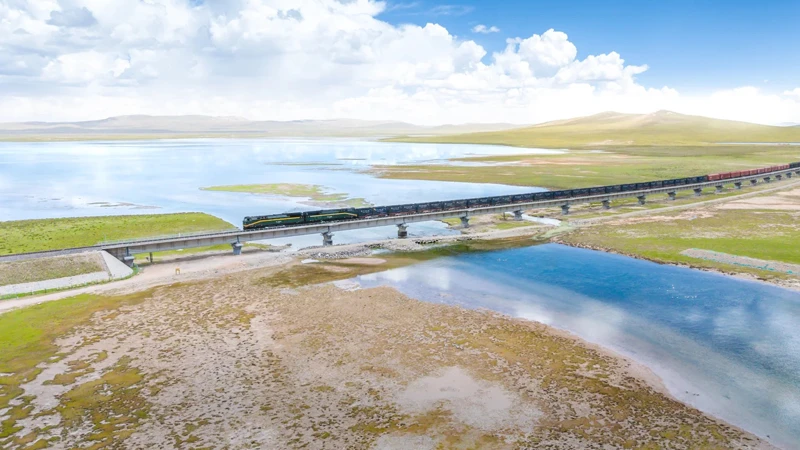
What You See on the Qinghai-Tibet Railway
The journey becomes much more interesting after Golmud.
The landscape opens up. The Qaidam Basin gives way to the high plateau, followed by the Kunlun Mountains, wide grasslands, Tuotuo River, Tanggula Pass and the northern Tibetan plateau around Nagqu.
There are long stretches when the view outside is simply grassland, mountains and sky.
The train does not stop at every scenic point, of course. This is not a sightseeing train. You watch through the window, take a few photographs, drink tea and wait for the landscape to change.
That slow pace is part of the experience.
The railway reaches elevations of more than 5,000 meters in sections, and the trains are equipped for high-altitude operation, including an oxygen supply system. But the train does not make you immune to altitude. Once you arrive in Lhasa, you still need to give yourself time to adjust.
Which Is the Best Train from Xining to Lhasa?
I would not choose a train simply because its number appears on a “best train” list.
Look at three things:
- How much of the plateau journey will be in daylight?
- Is a sleeper available?
- Does the arrival time work well with your Lhasa itinerary?
For many travelers, a daytime departure from Xining is attractive because more of the Qinghai-Tibet Railway is visible while you are awake.
A later departure can work better if you prefer to sleep through part of the journey.
The important thing is to match the train to the rest of your trip rather than treating the train as a separate booking.
Xining to Lhasa Train vs Lhasa to Xining Train
If you are deciding which direction to take the train, I prefer Xining → Lhasa for a first Tibet trip.
You start around 2,200 meters in Xining and spend many hours crossing the plateau before reaching Lhasa at about 3,650 meters. That does not remove altitude risk, but the transition is much less abrupt than flying directly into Lhasa.
There is also something satisfying about watching the landscape change as you move toward Tibet.
For the return journey, I would be less concerned about taking the train. If you have already acclimatized and your holiday is coming to an end, flying back to Xining can save you almost a full day.
So my usual choice would be:
Train into Tibet. Fly out if time matters.
Can You Book a Solo Cabin on the Xining–Lhasa Train?
This is a common question from solo travelers.
Normally, no.
A standard soft sleeper compartment has four berths. Buying one soft sleeper ticket gives you one berth, not the whole compartment.
If you are traveling alone, the other three berths can be occupied by other passengers.
If four people are traveling together, you can try to book all four soft-sleeper berths in the same compartment. Availability is the difficult part.
For a solo traveler, soft sleeper is still the class I would choose. It gives you a door, four berths rather than six, and a quieter environment than hard sleeper. It just is not a private room.
Get to Tibet from Xining by Flight
Flying is much simpler if your priority is time.
The direct air distance from Xining Caojiabao Airport (XNN) to Lhasa Gonggar Airport (LXA) is about 1,310 km. As of August 2026, the route has three nonstop airlines — Tibet Airlines, Sichuan Airlines and Lucky Air — with around 27 flights per week, or roughly four flights per day on average. The fastest scheduled flights take about 2 hours 25 minutes.
Xining to Lhasa Flight Schedule
Flight schedules move around more than train schedules, so I would not publish one fixed timetable and expect it to stay correct for the whole year.
Current August 2026 schedules show services such as:
| Airline | Flight | Example departure | Example arrival | Flight time |
|---|---|---|---|---|
| Lucky Air | 8L9517 | 09:35 | 12:00 | ~2h 25m |
| Tibet Airlines | TV9792 | 10:45 | 12:55 | ~2h 10m |
| Sichuan Airlines | 3U3453 | 12:45–13:10 | 15:05–15:40 | ~2h 20–30m |
| Tibet Airlines | TV9874 | 17:50 | 20:15 | ~2h 25m |
| Tibet Airlines | TV9988 | 19:55–21:35 | 22:25–23:35 | ~2h 30m |
Not every flight operates every day. The current route has departures roughly between 09:35 and 21:40, depending on the date.
Airfare is more difficult to give as one reliable number. It changes with date, demand, cabin and how early you book. For planning purposes, I would allow around RMB 1,000–2,500 one way, then check your exact date before setting the final budget.
There is one thing I would not do: arrive in Lhasa late at night and immediately start a demanding Tibet road trip the next morning.
The flight is short.
Your body still needs time.
Train or Flight from Xining?
I use a simple rule:
Take the train when you want to experience the journey. Fly when the journey is only transportation.
With 10–15 days available, I would make room for the train.
With seven or eight days, I would rather save the day and spend it in Tibet.
Get to Tibet from Xining by Road: Qinghai-Tibet Highway G109
G109 is different from the train and flight.
You should not choose it simply because you need to reach Lhasa.
Choose it because you want to travel across the plateau by road.
The route from Xining to Lhasa is roughly 1,900 km, depending on the exact route and stops. A realistic overland journey takes around four to six days.
| Road section | Distance | Duration | What you see |
|---|---|---|---|
| Xining → Delingha | ~500 km | 7–9 hrs | Qinghai countryside and Qaidam Basin |
| Delingha → Golmud | ~330 km | 5–6 hrs | Desert and salt-lake landscapes |
| Golmud → Tuotuo River | ~500 km | 7–9 hrs | Kunlun Mountains and high plateau |
| Tuotuo River → Nagqu | ~400 km | 6–8 hrs | Grasslands and Tanggula region |
| Nagqu → Lhasa | ~330 km | 5–7 hrs | Northern Tibet and the approach to Lhasa |
These are planning figures, not promises. Weather, road controls, traffic and altitude can all change the driving time.
I would be particularly careful about itineraries that promise to cover enormous distances every day.
A 10-hour driving day on a normal highway is one thing.
A 10-hour driving day on the Tibetan Plateau is another.
The train is much easier.
The road is much more flexible.
You can stop, take photographs, stay overnight in smaller places and actually feel the distance between Qinghai and Tibet.
If that is what you want, G109 can be a very good part of the trip.
3. Xining Tibet Trip Requirements: Chinese Tourist Visa and Tibet Travel Permits
Getting to Xining is one question.
Getting from Xining into Tibet is another.
Foreign travelers need to meet China’s entry requirements. Depending on your nationality and the policy applicable to your trip, this may mean a Chinese Tourist Visa or eligibility for visa-free entry.
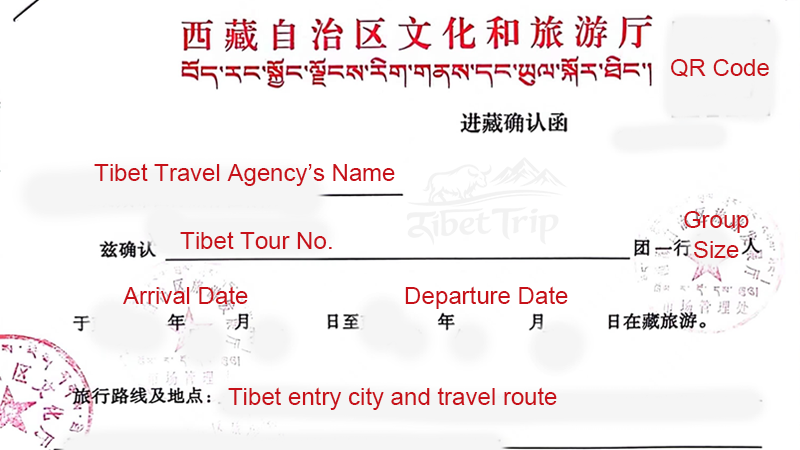
You also need a Tibet Travel Permit to enter the Tibet Autonomous Region.
The permit is not something you normally obtain independently. It is coordinated through the licensed Tibet operating partner for your confirmed Tibet itinerary.
If you enter Tibet by train, the permit is also relevant to the railway boarding process.
What Permits Do You Need in 2026?
The important change many older Tibet articles have missed is the June 4, 2025 Aliens’ Travel Permit exemption.
For several regular tourist routes, foreign travelers no longer need the Aliens’ Travel Permit. The exemption covers popular routes including the regular Everest Base Camp route, Nyingchi scenic areas, parts of Shannan and the standard G318 route. Current 2026 sources continue to report these exemptions.
For a simple comparison:
| Tibet trip | Tibet Travel Permit | Aliens’ Travel Permit | Other permits |
|---|---|---|---|
| Lhasa | ✓ | No | — |
| Lhasa + regular Nyingchi route | ✓ | Generally no | Check exact itinerary |
| Lhasa + regular Everest route | ✓ | Generally no | Check exact itinerary |
| Mount Kailash + Mansarovar | ✓ | ✓ | Military/border permissions may also be required |
For Mount Kailash and Lake Mansarovar, the rules are different. The route enters the remote Ngari region and still requires additional permissions, including the Aliens’ Travel Permit and Military Area Entry Permit.
So if an old article tells you that every foreign traveler going to Everest automatically needs an Aliens’ Travel Permit, check the publication date. That information may predate the 2025 change.
Permit rules can still change, especially for border and restricted areas. Your exact route should be checked before you finalize transportation.
4. Find the Best Time for a Xining Tibet Trip
The best time depends more on where you want to go after Lhasa than on Xining itself.
April–May
Good for Lhasa and the main central Tibet routes. Higher areas can still be cold, particularly at night.
June
A very good all-round period. The plateau is greener, temperatures are generally comfortable during the day, and the main tourist season is beginning.
July–August
This is peak travel season. You can still have excellent weather, but cloud and rain are more common in some Himalayan and southeastern areas. Everest and western Tibet need more attention to weather than Lhasa.
September–October
Often one of the nicest periods for clear mountain views and comfortable daytime temperatures.
Winter
Winter is much quieter. Lhasa can have bright, sunny days, but higher and remote areas are much colder. Some travelers love the lower crowds; others would rather avoid the cold.
For a train trip from Xining, I would choose the season based on the Tibet route you want to take afterward.
5. Budget Tibet Trip from Xining: How Much Does It Cost?
The Xining–Lhasa transportation cost is only one part of your budget.
Your biggest expense will normally be the Tibet trip itself.
As a rough planning guide:
| Expense | Typical planning range |
|---|---|
| Xining → Lhasa hard sleeper | ~¥500 |
| Xining → Lhasa soft sleeper | ~¥780–800 |
| Xining → Lhasa flight | ~¥1,000–2,500 one way |
| Lhasa-focused group tour | ~US$600–1,000+ |
| Lhasa + Everest group tour | ~US$900–1,400+ |
| Private Tibet trip | ~US$1,200–2,500+ |
| Kailash itinerary | ~US$1,800–3,000+ |
These are not quotations. Hotel level, group size, season, itinerary and transport availability can move the price considerably.
For solo travelers, joining a group can make the Tibet portion much more affordable because transportation and other tour costs are shared.
For couples or small groups, a private itinerary can become more reasonable because the vehicle cost is shared among the travelers.
I would compare more than the headline price.
Look at the number of days, the driving hours, hotel locations, acclimatization time and what is actually included.
A cheaper Tibet itinerary is not necessarily better value if you spend most of it sitting in a vehicle.
6. Xining to Tibet Trip FAQs
Is Xining a good place to start a Tibet trip?
Yes. It is particularly good for travelers who want to experience the Qinghai-Tibet Railway without spending 30–40 hours on a train from another Chinese city.
How far is Xining from Lhasa?
The air distance is about 1,310 km. The railway distance is around 1,956–1,972 km, and the road journey is roughly 1,900 km.
How long is the Xining to Lhasa train?
Most services take around 20–22 hours, although the exact duration depends on the train and timetable.
Is the Xining to Lhasa train worth taking?
For a first Tibet trip, I think it is. The Xining–Lhasa section gives you the main Qinghai-Tibet Railway experience without the extra day or two spent traveling from eastern China.
Is it better to take the train to Lhasa or from Lhasa to Xining?
I prefer Xining → Lhasa for a first visit. If you are already acclimatized at the end of your trip, flying back to Xining can save time.
Can I take a train from Lhasa back to Xining?
Yes. Regular Lhasa–Xining services operate, although train numbers and times change with the railway timetable.
Can I book a private cabin on the Xining–Lhasa train?
Not as a normal single-person booking. A soft sleeper has four berths. To have the compartment to yourself, you would generally need to secure all four berths.
Should I book hard sleeper or soft sleeper?
I would choose soft sleeper if the price fits your budget. The journey is long enough that the extra privacy and quieter compartment are worthwhile.
Is flying from Xining to Lhasa safe?
Direct flights are the fastest option, but remember that you reach Lhasa’s 3,650-meter altitude very quickly. Plan a quiet first day rather than scheduling a demanding road trip immediately after landing.
Can I drive from Xining to Lhasa?
Yes. The G109 Qinghai-Tibet Highway connects the two cities, but it should be treated as a multi-day high-altitude overland journey rather than a simple transfer.
Is G109 better than the train?
Not really “better.” They suit different travelers. The train is easier and more efficient. G109 gives you more freedom to stop and experience the road.
Do I need a Chinese Tourist Visa to travel from Xining to Tibet?
You need to satisfy China’s entry requirements. Depending on your nationality, this may mean a Chinese Tourist Visa or visa-free eligibility. The Chinese visa or visa-free status does not replace the Tibet Travel Permit.
Do I need an Aliens’ Travel Permit for Everest in 2026?
For the regular Everest tourist route, the Aliens’ Travel Permit exemption introduced in June 2025 remains applicable according to current 2026 sources. Your exact itinerary should still be checked before departure.
Do I need an Aliens’ Travel Permit for Nyingchi?
Regular Nyingchi tourist routes are included in the current exemption. Special or restricted routes can have different requirements.
What permits do I need for Mount Kailash?
For a Mount Kailash and Lake Mansarovar trip, plan for the Tibet Travel Permit, Aliens’ Travel Permit and Military Area Entry Permit, together with any other permissions required for the specific route.
Should I stay one night in Xining before taking the train?
If you are arriving in Xining from another Chinese city, I would. It gives you some breathing room if your previous flight or train is delayed, and you do not have to start a 20-hour railway journey already exhausted.
How many days should I plan for Tibet after arriving from Xining?
For Lhasa, allow at least several days rather than treating it as a one-night stop. For Lhasa + Everest, around 8–10 days is a more comfortable starting point. For Kailash, you need considerably longer because the journey to western Tibet is long and the altitude becomes a major part of the planning.
My Practical Recommendation
If you are in Xining and still deciding how to enter Tibet, I would keep it simple.
Take the train if you want to experience the plateau. Fly if you need the time. Take G109 if the road itself is part of the reason you are coming.
For most first-time travelers with enough days, my choice would be Xining → Lhasa by train, followed by several days in Lhasa before moving to higher destinations.
Do not make the first day in Lhasa too ambitious.
Do not choose a road itinerary simply because it looks shorter on a map.
And do not book the cheapest Tibet itinerary without checking how much time you will actually spend on the road.
I built TibetTrip around these kinds of decisions. I’m Metok, a local Tibetan, and my role is to help international travelers understand Tibet, compare routes and plan a realistic trip. TibetTrip does not currently operate the tours on the ground. When you decide to proceed with a tour, your enquiry can be introduced to our licensed Tibet operating partner, who handles the formal contract, payment, required permits and on-the-ground operation.
If you already know your Xining arrival date, Tibet travel dates, number of travelers and whether you want Lhasa, Everest, Nyingchi or Kailash, send me those details.
I can help you compare the train, flight and road options before you decide.