
If you are planning a Tibet Trip from Chongqing, you have an unusually interesting way to reach Lhasa: a direct train.
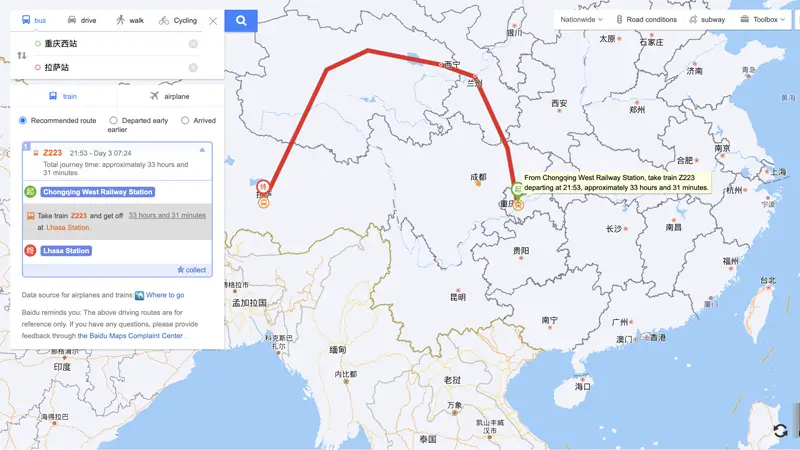
The current Z223 service leaves Chongqing West Railway Station in the evening and reaches Lhasa on the third morning. The journey takes about 33 hours 39 minutes, with reference fares of around RMB 302.5 for a hard seat, RMB 627.5 for a hard sleeper and RMB 997.5 for a soft sleeper. Train times and availability can change, so the final schedule should always be checked for your travel date.
Flying is much quicker. Direct Chongqing–Lhasa flights generally take around 3 hours, depending on the service and operating schedule.
So there is no complicated answer here.
If your Tibet holiday is short, fly.
If you have more time and actually enjoy long-distance train travel, the Chongqing–Lhasa train is worth considering.
I’m Metok, a Tibetan and the person behind TibetTrip. When I help travelers plan a Tibet trip, I prefer to start with the shape of the journey rather than tell everyone to use the same route. From Chongqing, that matters because the train itself can become part of your Tibet experience.
Chongqing to Tibet at a Glance
| Travel option | Duration | Best for |
|---|---|---|
| Chongqing → Lhasa direct flight | About 3 hours | Short trips and travelers who want to save time |
| Chongqing → Lhasa direct train | About 33–34 hours | Travelers who enjoy trains and have extra days |
| Chongqing → Xining → Lhasa | Longer | A useful alternative when the direct train does not fit |
| Overland journey | Several days | Travelers who want the road journey itself |
For most first-time visitors, I would not make this more complicated than it needs to be.
Choose the flight when your time in Tibet is more valuable than your time on the railway.
Choose the train when you would genuinely enjoy watching the journey unfold.
That is a more useful way to look at the choice than simply asking which one is “better.”
Why Chongqing Makes a Good Starting Point
Chongqing is a very different place from Lhasa.
The city is humid, busy and built across steep hills. There are bridges, rivers, dense neighborhoods, hotpot restaurants and streets that seem to go uphill when you thought you were walking downhill.
Then the journey west begins.
If you take the train, the change is gradual. The first part still feels like a normal long-distance journey through Chinese Mainland. Later, after Lanzhou and Xining, the landscape becomes much more open. The railway continues through the high plateau toward Golmud and then across the Qinghai–Tibet section to Lhasa.
That gradual change is one of the strongest reasons to choose the train.
It is not simply transportation from point A to point B.
You have time to notice the country getting wider and quieter.
If you have never visited Chongqing, staying for a night or two before leaving can also be worthwhile. You do not need to turn it into another major sightseeing trip. Eat something you like, walk around the city, sleep properly and then start the long journey west.
If Chongqing is only your connection point, that is fine too. There is no need to add sightseeing just because you happen to pass through the city.
Taking the Chongqing–Lhasa Train
The direct service is Z223, departing from Chongqing West Railway Station.
Current timetable information gives the following as a useful reference:
| Z223 | Current reference |
|---|---|
| Departure | Chongqing West, around 21:45 |
| Arrival | Lhasa, around 07:24 on the third day |
| Journey | About 33 hr 39 min |
| Main stops | Guangyuan, Lanzhou, Xining, Delingha, Golmud |
| Destination | Lhasa |
The exact departure time can change between timetable updates, so treat these figures as a current reference rather than a promise for every date. Check the actual departure date on China Railway 12306 before making your final travel arrangements.
The important thing to understand is the rhythm of the trip.
You leave Chongqing at night.
You wake up the next morning somewhere much farther west.
The train continues through Lanzhou and Xining before heading toward the plateau. By the time it reaches the Qinghai–Tibet Railway section, you have already spent more than a day on the train.
You then arrive in Lhasa the following morning.
For someone who likes railway travel, that can be a very satisfying way to begin Tibet.
For someone who finds even a six-hour train ride tiring, I would not pretend otherwise: it is a long journey.
Which Train Class Should You Choose?
Current reference fares for Z223 are approximately:
| Class | Indicative fare |
|---|---|
| Hard seat | RMB 302.5 |
| Hard sleeper | RMB 627.5 |
| Soft sleeper | RMB 997.5 |
These prices are reference fares and can change with the travel date and ticket availability.
For a journey of more than 30 hours, I would choose a sleeper if your budget allows it.
The difference is not only comfort.
You will spend two nights on the train. Being able to lie down, sleep and keep your belongings close makes the second half of the journey much easier.
Keep the things you may need during the journey in a smaller bag:
- Passport and travel documents
- Medicine
- Toiletries
- Phone charger
- Water
- Snacks
- A light jacket
Your main luggage can stay where it is.
This sounds like a small detail, but it becomes surprisingly useful once you are settled into a sleeper compartment.
What Will You See From the Train?
I would not take the train expecting thirty-four hours of nonstop spectacular scenery.
That is not how the journey works.
There are dark hours, ordinary railway sections and long periods when you are simply sitting in your berth. You may read, sleep, listen to music or talk with other passengers.
The landscape becomes more interesting as the train moves beyond Xining toward the Qinghai–Tibet Plateau.
The land opens up.
Buildings become less frequent.
The mountains start to feel farther away and larger at the same time.
You may see broad grasslands, mountain ranges and open stretches of plateau. Depending on the season and weather, the view can change considerably.
The best part is not one particular landmark.
It is the change itself.
You have enough time to notice it.
Flying from Chongqing to Lhasa
If the train sounds like too much time, the flight is straightforward.
Direct services operate from Chongqing Jiangbei International Airport (CKG) to Lhasa Gonggar Airport (LXA). Flight schedules and operating airlines vary by date, but direct flights generally take around three hours.
That is a huge difference compared with the train.
A flight makes much more sense when you have only a week in Tibet and want to spend those days actually traveling around Tibet rather than getting there.
There is, however, one thing I would plan carefully: your first day in Lhasa.
Lhasa is around 3,650 meters above sea level. Flying takes you from Chongqing to that altitude in a few hours.
That does not mean you should be afraid of flying. It simply means you should leave some space in your schedule after arrival.
Do not land in Lhasa at midday and immediately plan a full afternoon of demanding sightseeing followed by a late dinner and an early departure the next morning.
Your body may have other ideas.
A slower first day is usually the more sensible choice.
Give Yourself Time in Lhasa
Whether you arrive by train or plane, I would protect your first full day in Lhasa.
The temptation is always the same: you have traveled a long way, so you want to start seeing everything immediately.
But Lhasa is high.
Altitude affects people differently, and even travelers who feel fine at first can become tired later.
Your first day does not need to be empty. A gentle walk, a relaxed meal and some time around the old city can be enough.
Then you can start filling the following days with places such as Potala Palace, Jokhang Temple and the Barkhor area.
The Potala Palace will still be there tomorrow.
That is one of the few times on a Tibet trip when doing less on the first day is actually part of good planning.
What Kind of Tibet Trip Can You Build From Chongqing?
Once you reach Lhasa, the right route depends on what brought you to Tibet in the first place.
Culture and History
Stay longer in Lhasa.
This gives you time for the major sights without turning every day into a checklist.
Mountains and Everest
Continue west toward Shigatse and Everest Base Camp.
This route involves longer road journeys and higher elevations, so it needs more time than a simple Lhasa visit.
A Longer Western Tibet Journey
If your dream is Mount Kailash and Lake Manasarovar, think in terms of a much longer trip.
Do not try to squeeze Kailash into a short Chongqing–Lhasa holiday simply because the places look close on a map.
They are not.
The distances in Tibet are large, and altitude changes the way you experience those distances.
A Small Point About Tibet Maps
This is worth saying because travelers can easily underestimate it.
A map can make Tibet look deceptively compact.
Lhasa to Shigatse is one thing. Going farther west toward Everest or Ngari is another.
A route that appears manageable because two destinations are connected by a line on a map may still involve many hours on the road.
When I look at a Tibet itinerary, I pay attention to:
- Actual driving time
- Altitude changes
- Road conditions
- Where you will sleep
- How many demanding days come one after another
The number of kilometers is only part of the picture.
That is why I would rather remove one destination from an itinerary than turn the whole trip into a race.
Tibet Travel Permit for a Chongqing–Tibet Trip
If you are a foreign traveler, entering Tibet requires the applicable Tibet travel authorization and an organized travel arrangement.
The Tibet Travel Permit is the main permit for entering the Tibet Autonomous Region. Depending on your route, additional permits or authorizations may be required.
This is something to sort out before you treat your Chongqing transport as a separate problem.
For example, a traveler planning only Lhasa has a different planning situation from someone continuing to Mount Kailash or other restricted areas.
TibetTrip can help you understand which documents and route arrangements are relevant to your plan. If you decide to proceed with a tour, the formal permit application and operational arrangements are handled by our licensed Tibet operating partner.
That distinction is important. TibetTrip is the travel-planning and enquiry side; the licensed operating partner is responsible for the formal travel operation, including the applicable contract, payment, permits and on-the-ground services.
Can You Just Take the Train and Figure Out Tibet Later?
I would not plan it that way.
You can arrange your travel around Chinese Mainland quite independently, but Tibet has its own entry and travel requirements for foreign visitors.
So buying a Chongqing–Lhasa train ticket is not the same thing as having your Tibet trip arranged.
It is better to decide first:
Where do you want to go in Tibet?
Then:
How many days do you have?
Then:
Which transport from Chongqing fits that plan?
This order prevents a common problem: choosing a train because it looks exciting and then discovering that you no longer have enough time for the Tibet route you actually wanted.
What Should You Pack for the Journey?
Chongqing and Tibet can feel like two completely different climates.
Chongqing can be warm and humid. Lhasa is much drier, with strong sunlight and large temperature differences between day and night.
Layers are more useful than one very heavy piece of clothing.
For the train, I would also keep a few practical items within easy reach:
- Comfortable clothes for sleeping
- A light warm layer
- Sunglasses
- Sunscreen
- Personal medicine
- Lip balm or moisturizer
- Tissues
- Water
- Snacks
- Power bank or charger
You do not need to pack your entire life for the train.
Just make sure the small things you need during the night are not buried at the bottom of your suitcase.
Should You Stay in Chongqing Before the Train?
If you have the time, yes.
Not because you need to tick Chongqing off a sightseeing list.
Simply because beginning a long Tibet journey after a rushed arrival is not ideal.
A night in Chongqing gives you some margin if your international flight or previous train is delayed. It also means you can reach Chongqing West Railway Station without starting the day already exhausted.
And if you enjoy food, Chongqing is a good place to eat before heading into the plateau.
Have your hotpot.
Walk through the city.
Get some sleep.
Then board the train.
There is something quite nice about that sequence.
My Practical Advice for a Tibet Trip from Chongqing
I would not choose your transport first.
Choose the Tibet experience first.
If your priority is seeing Lhasa, Everest or other parts of Tibet and your holiday is short, fly from Chongqing.
If you have enough time and like trains, Z223 gives you something that a flight cannot: a long, gradual journey from the southwest of China across the plateau toward Lhasa.
And if you are somewhere in the middle, look at the actual number of days you have before making the decision.
There is no prize for spending thirty-four hours on a train if you would rather have that time in Tibet.
There is also no reason to fly if the railway journey is one of the experiences you have been looking forward to.
The best choice is the one that fits the trip you actually want.
Chongqing to Tibet FAQ
Is there a direct train from Chongqing to Lhasa?
Yes. The current direct service is Z223, departing from Chongqing West and continuing to Lhasa. The journey takes roughly 33–34 hours, although the exact timetable can change.
How much is the Chongqing to Lhasa train?
Current reference fares are approximately RMB 302.5 for hard seat, RMB 627.5 for hard sleeper and RMB 997.5 for soft sleeper. Actual fares and availability depend on the travel date and ticket availability.
How long is the flight from Chongqing to Lhasa?
Direct flights generally take around three hours, although the exact flying time and schedule vary by service and travel date.
Is the train better than flying from Chongqing to Tibet?
Not necessarily. The train is better suited to travelers who enjoy the railway journey and have enough time. Flying is the more practical choice when your Tibet holiday is short.
How many days should I plan for a Tibet Trip from Chongqing?
Around 7–8 days can work for a focused trip if you fly. Ten to twelve days gives you more flexibility, while two weeks or more makes the direct train easier to fit into the overall journey.
Will taking the train prevent altitude sickness?
No. The train gives you a more gradual journey toward the plateau, but it does not guarantee that you will avoid altitude-related problems. You should still plan time to rest and acclimatize in Lhasa.
Do foreign travelers need a Tibet Travel Permit?
Yes. Foreign travelers need the applicable Tibet travel authorization before entering Tibet, and additional permits may be required for some destinations.
Can I travel independently in Tibet after arriving from Chongqing?
Tibet travel for foreign visitors is subject to specific travel requirements and organized travel arrangements. It is better to have your Tibet route and required documentation arranged before you travel from Chongqing.
Is Chongqing worth visiting before Tibet?
If your schedule allows it, I think so. You do not need several days. Even one night can give you time to experience the city, eat well and start the journey west without rushing.
Plan Your Tibet Trip from Chongqing
A Chongqing–Tibet journey can be as simple as a three-hour flight to Lhasa, or it can begin with two nights on a train and slowly cross the country toward the plateau.
Neither is the “correct” version.
What matters is what you want those days to feel like.
If you already know your travel dates, the number of people traveling and roughly how long you have, tell me those details. I can help you compare the train and flight options, look at a realistic Tibet route and explain which parts of the journey deserve more time.
That is what I want TibetTrip to be useful for: not telling every traveler to take the same route, but helping you understand what the different choices actually mean before you book.