



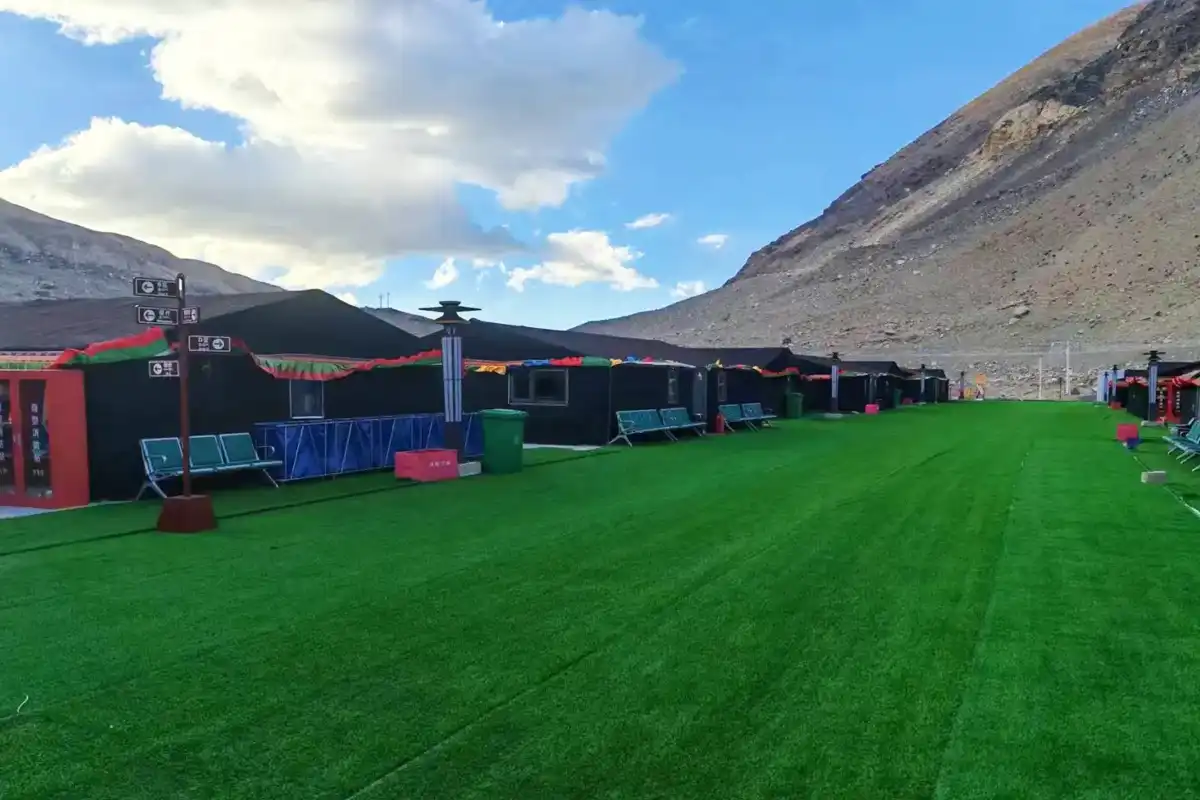
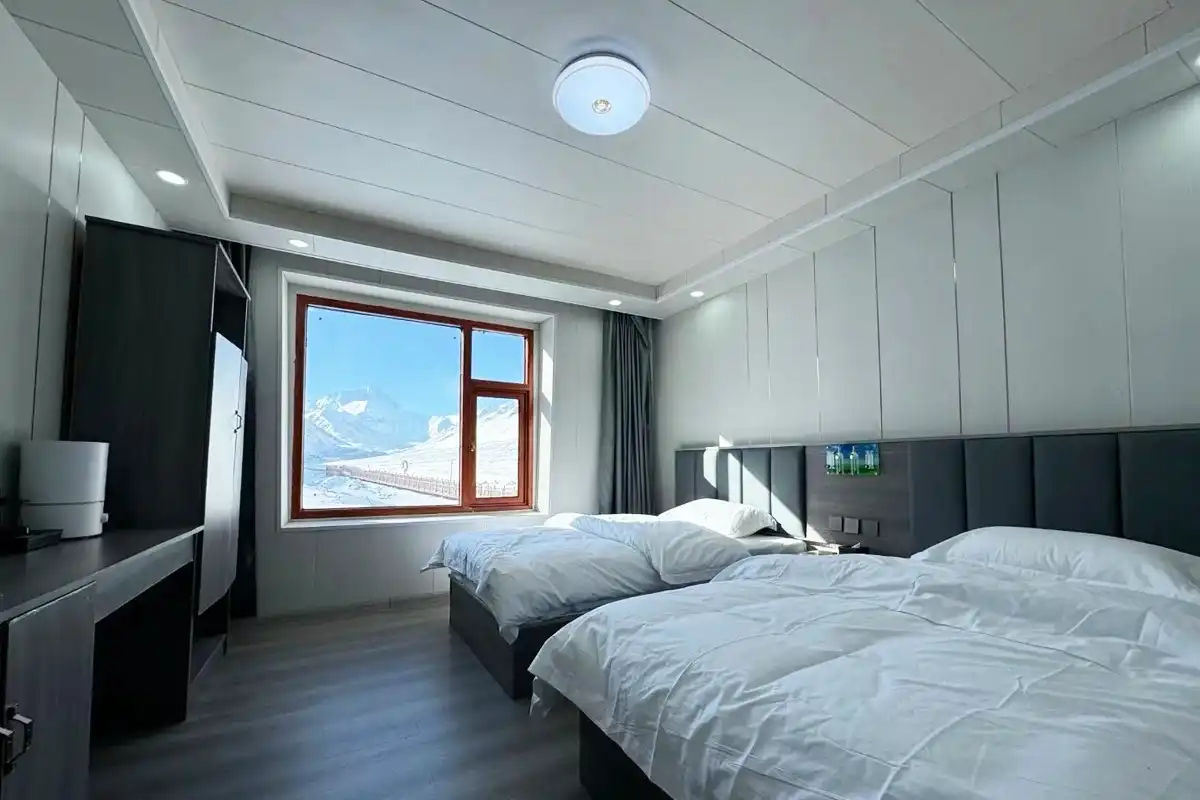
Accommodation near Everest Base Camp is basic compared with hotels in Lhasa or Shigatse, but travelers now have several options depending on comfort, altitude and availability.
Near Everest, travelers may stay in seasonal tent guesthouses or Rongbuk-area accommodation. Another option is to stay at a lower elevation, such as Zhaxizong Township, before or after visiting the Everest scenic area.
Staying closer to Everest gives you more time around the mountain and better opportunities for sunset, sunrise and night-sky photography. Staying at a lower elevation can provide a more comfortable night’s sleep and may be preferable for families, older travelers or anyone who finds high altitude difficult.
Accommodation included in a Tibet Everest Base Camp tour depends on the itinerary, season and availability. If accommodation quality is important to you, ask where you will sleep each night before choosing a tour.
Yes. Restaurants and restrooms are available along the main Lhasa–Everest route, although facilities become increasingly basic as you travel farther from the larger towns.
Gyantse and Shigatse offer a wider choice of restaurants and more developed facilities. At mountain passes, viewpoints and remote sections of the Everest route, services are simpler.
Meals commonly include Tibetan and Chinese dishes such as rice, noodles, vegetables, eggs, soups and meat dishes. Restaurants near Everest have fewer choices than those in Lhasa or Shigatse.
Carry tissues, wet wipes, water and a few snacks in your daypack. It is also useful to keep some small cash for occasional restroom fees.
Food on a Tibet Everest Base Camp tour is generally simple and filling, with Tibetan and Chinese dishes available along the route.
In Lhasa, Shigatse and other larger towns, you will find a wider range of restaurants. As you approach Everest, choices become more limited and meals tend to be simpler.
Typical dishes include noodles, fried rice, vegetables, eggs, soups, Tibetan noodle soup and, where available, Tibetan specialties such as yak meat. Yak hotpot may also be available at selected restaurants, but it should not be treated as a standard inclusion in every Everest tour.
Vegetarian travelers can usually find vegetable noodles, fried rice, tofu and seasonal vegetables. If you have allergies, dietary restrictions or other special requirements, mention them when you enquire so the operating team can advise what can realistically be arranged.
Toilet facilities at Everest Base Camp are basic, although facilities in the scenic area and accommodation have improved compared with the past.
Hotels and guesthouses generally offer better facilities, while public toilets around viewpoints, monasteries and remote areas can be much simpler.
If you stay at accommodation with a private bathroom, you will have considerably more comfort than at public facilities around the scenic area. Conditions can also vary according to the season, location and current operation of the site.
Our practical advice is simple: carry tissues and wet wipes throughout the trip and do not assume that every stop will have a modern Western-style restroom.
Foreign travelers cannot normally apply for a Tibet Travel Permit independently. The permit is arranged through an authorized Tibet travel arrangement after your tour has been confirmed.
When you enquire through TibetTrip, we help you understand the route, entry requirements and documents you need to prepare. Once you decide to book, your enquiry is introduced to our licensed Tibet operating partner.
The licensed operator handles the travel contract, payment and required permit arrangements. Depending on your nationality, Chinese visa or visa-free status, entry route and travel dates, additional documentation may also be required.
Do not leave the permit process until the last minute. It is better to begin planning several weeks before your intended Tibet entry date.
For a detailed explanation, see our Tibet Travel Permit guide.
Choose the Tibet side if you want to see the North Face of Everest by road; choose the Nepal side if the multi-day trekking experience is the main purpose of your trip.
On the Tibet side, travelers can reach the Everest Base Camp area by vehicle and visit viewpoints around Rongbuk and the Everest scenic area. This makes it a practical option for travelers who want an Everest experience without a long trek.
The Nepal side is more focused on trekking through Himalayan valleys and Sherpa villages.
The two sides offer very different experiences rather than one being universally “better.” If your trip also includes Lhasa, Shigatse or other Tibet destinations, the Tibet-side route is often the more natural choice.
For most first-time visitors to Tibet, starting in Lhasa provides a more gradual approach to the high altitude around Everest.
Lhasa sits at about 3,650 meters, giving travelers an opportunity to spend several days acclimatizing before continuing toward Shigatse and Everest.
Starting from Kathmandu and entering Tibet through the Gyirong border creates a spectacular Nepal–Tibet overland journey, but the change in elevation can be more abrupt.
The best starting point depends on your wider trip. Travelers already visiting China may find Lhasa the most practical starting point, while travelers coming from Nepal may prefer Kathmandu.
If you are comparing a Lhasa–Everest tour with a Kathmandu–Tibet route, consider both acclimatization and your overall travel plans rather than simply comparing the number of days.
The road distance from Lhasa to the Everest Base Camp area is roughly 600–650 km, depending on the exact route and stops.
It is normally spread across several days rather than driven in one continuous journey. A typical overland itinerary uses the route to visit places such as Gyantse and Shigatse while gradually moving toward higher elevations.
The journey is more than a transfer from Lhasa to Everest. Along the way you pass high mountain passes, lakes, monasteries, Tibetan villages and wide-open plateau landscapes.
When comparing Tibet Everest Base Camp tours, do not look only at the distance. Check how many days the itinerary allows, where you stay each night and how much time is available for acclimatization.
Most of the main Lhasa–Everest route follows paved roads, but it remains a long high-altitude mountain journey with winding sections and mountain passes.
Road conditions can change with weather, maintenance and local conditions, so travel times should be treated as estimates.
Motion sickness is possible, particularly on winding mountain roads such as the famous 108 Bends. Travelers who are prone to carsickness may want to sit toward the front of the vehicle and carry appropriate medication recommended by their doctor.
The journey is generally more comfortable when the itinerary is divided into reasonable daily driving stages rather than trying to cover the route as quickly as possible.
The 108 Bends is a paved mountain road with many tight turns, so it looks dramatic but is a normal part of the overland route to Everest.
The road descends through a series of hairpin bends around the Gyawu La area and is one of the most recognizable sections of the Tibet Everest journey.
As with any high-altitude mountain road, conditions depend on weather, traffic and road conditions. Travelers should not assume that a paved road means there is zero risk.
If you are prone to motion sickness, prepare accordingly. Sitting toward the front of the vehicle, keeping your eyes on the road and taking appropriate medication can make the descent more comfortable.
The main photography stops are Gyatso La Pass, the 108 Bends, Gyawu La Pass and the Everest Base Camp/Rongbuk area.
Gyatso La Pass provides an early opportunity to see the Himalayan range as you approach Everest.
Gyawu La Pass offers one of the most famous panoramic views of the Himalayan peaks, including Everest on a clear day.
Rongbuk and the Everest Base Camp area provide a much closer view of the North Face and are particularly valuable for sunrise, sunset and night photography.
Weather is the biggest variable. No tour company can honestly guarantee a clear Everest summit view on a particular day. If photography is your priority, choose an itinerary that gives you enough time around Everest rather than treating the visit as a quick photo stop.
For relatively dry weather and clearer mountain views, spring and autumn are generally the most popular periods, particularly April–May and September–October.
Summer, especially July and August, is influenced by the Asian monsoon and can bring more clouds and rainfall. However, conditions vary from year to year.
Winter can offer very clear skies and fewer travelers, but temperatures around Everest can become extremely cold and some accommodation and services may operate differently.
There is no single best month for every traveler. Consider visibility, temperature, road conditions, accommodation availability, crowd levels and your tolerance for cold when choosing your travel dates.
If price is an important factor, ask about current group departures and seasonal differences before deciding when to travel.
Clear, dry and relatively moonless nights provide the best conditions for Milky Way photography around Everest.
Spring and autumn are generally favorable, although actual conditions depend on weather and the moon phase.
Night temperatures at Everest can fall well below freezing even when daytime temperatures are relatively comfortable. Cold temperatures can also drain camera and phone batteries quickly, so keep spare batteries close to your body and carry a tripod for long exposures.
If night photography is one of your main reasons for visiting Everest, consider staying close to the mountain rather than returning to a lower-elevation town immediately after sunset.
Above all, do not stay outside for too long simply to get a photograph. At around 5,200 meters, cold and altitude deserve more attention than the perfect shot.
Yes, children and older travelers can visit the Tibet side of Everest, but age alone does not determine whether the journey is suitable.
The main advantage of the Tibet route is that most of the journey to Everest is by vehicle rather than several days of trekking. This makes it more accessible than the classic Nepal-side Everest trek.
However, Everest Base Camp is around 5,200 meters above sea level, and altitude is a serious consideration for travelers of any age.
Families should allow adequate acclimatization time and avoid rushing the itinerary. Older travelers or anyone with existing health concerns should discuss the trip with a qualified medical professional before traveling.
When choosing a tour, look at the pace of the itinerary, overnight elevations and daily driving distances rather than simply asking whether there is an age limit.
Altitude sickness is a genuine risk at Everest Base Camp, which is around 5,200 meters above sea level, and every traveler should take it seriously.
People respond differently to altitude, and being young or physically fit does not guarantee that you will avoid symptoms.
Mild symptoms can include headache, fatigue, dizziness, shortness of breath and difficulty sleeping. Gradual acclimatization, adequate rest, hydration and avoiding unnecessary exertion can reduce the strain on your body.
A well-planned itinerary should allow time at lower elevations before reaching Everest rather than rushing directly from a much lower altitude.
Oxygen can sometimes be used as emergency support, but it should not be treated as a substitute for acclimatization or professional medical care.
If symptoms become severe or continue to worsen, tell your guide immediately and seek professional medical advice. In serious cases, descending to a lower altitude may be necessary.
Medical facilities are more accessible in Lhasa and Shigatse than in the remote Everest region, so travelers should not expect hospital-level services near Base Camp.
Lhasa and Shigatse have larger hospitals and medical facilities. As you travel farther west toward Everest, medical resources become more limited and may consist mainly of local clinics and emergency support.
If you feel unwell, tell your guide or tour team immediately rather than waiting for symptoms to become severe.
A responsible Everest itinerary should include realistic driving times and a plan for dealing with altitude-related problems. Depending on the situation, this may mean stopping the ascent, seeking medical assistance or descending to a lower elevation.
Before booking, ask what emergency procedures and transportation support are included in the specific tour you are considering.
Choose Everest if your priority is Himalayan scenery and seeing the North Face by road; choose Mount Kailash if you are looking for a pilgrimage and high-altitude trekking experience.
A Tibet Everest Base Camp tour is mainly an overland journey. You spend much of the trip traveling by vehicle between Lhasa, Shigatse and the Everest region, with time for sightseeing and photography.
A Mount Kailash journey is centered on the sacred mountain and its three-day kora, including the high Dolma La Pass.
If you have limited time and mainly want to see Everest, an EBC tour is usually the simpler choice.
If you have more time and want a spiritual journey involving several days of trekking, Mount Kailash may be more suitable.
Yes. Tibet has trekking routes to Everest, although most visitors choose the road-accessible Everest Base Camp tour.
The Old Tingri–Everest Base Camp route is one of the better-known Tibet-side trekking options. It offers several days of walking through high-altitude valleys, pastures and remote landscapes.
A Tibet EBC trek is considerably more demanding than a vehicle-based tour. You should have previous trekking experience, prepare physically and understand that altitude is a major factor.
If you prefer walking to sightseeing by vehicle, mention your previous trekking experience, preferred dates and desired route when enquiring. This makes it easier to determine whether a trekking itinerary is appropriate.
A standard Tibet Everest Base Camp tour does not allow you to climb Mount Everest.
Actual summit climbing is a highly specialized mountaineering activity requiring extensive experience, physical preparation, technical equipment, permits and professional expedition support.
For ordinary travelers, the Tibet-side Everest Base Camp experience brings you to the Everest Base Camp area at roughly 5,200 meters, where you can see the North Face from close range.
You can visit the Everest Base Camp area, explore around Rongbuk, photograph the mountain and experience sunrise, sunset or the night sky without attempting a summit climb.
The important distinction is simple: an Everest Base Camp tour is a sightseeing and high-altitude travel experience, not a mountaineering expedition.
A standard vehicle-based Tibet EBC tour does not require technical mountaineering equipment. Warm clothing, good walking shoes, sun protection and personal medication are the essentials.
We recommend packing:
- Warm down or insulated jacket
- Thermal base layers
- Fleece or warm mid-layer
- Comfortable walking or waterproof trekking shoes
- Warm hat and gloves
- UV-protective sunglasses
- High-SPF sunscreen and lip balm
- Personal prescription medication
- Basic medicines recommended by your doctor
- Reusable water bottle
- Tissues and wet wipes
- Power bank and spare camera batteries
Temperatures can drop sharply after sunset around Everest, even during warmer months, so warm layers are important.
You do not need to pack heavy climbing equipment for a standard EBC road tour. If you plan to trek, your packing list will be different and should include appropriate trekking equipment.
If you have specific medical, dietary or mobility requirements, mention them when enquiring so the available arrangements can be checked before booking.